Your glucose, your life: Why one-size-fits-all health advice can fall short
Published: Sep. 3, 2026
Updated: Sep. 14, 2026
3 min read

The content in this article should not be taken as medical advice. Please consult with your healthcare provider regarding your individual health needs.
Have you ever noticed how two people can follow the same health advice and get completely different results? Maybe a friend starts eating a balanced breakfast every morning and notices more energy throughout the day. Or one person you know swears by 10-minute walks after dinner, while another notices a bigger difference from strength training. Or a meal that leaves one person feeling energized might leave someone else reaching for a nap an hour later.
It's easy to see these experiences and assume someone must be doing something wrong. But what if they're simply experiencing their own biology?
For years, health recommendations have been built around what tends to work well for most people. That's not a flaw; it's how evidence-based guidance helps millions of people make informed decisions. But averages can only tell part of the story.
As researchers learn more about metabolic health, they're uncovering something that many people have experienced firsthand: the same food, habit, or routine doesn't always produce the same response in everyone.
What glucose can teach us about individuality
One of the clearest examples comes from glucose. In a landmark study published in Cell, researchers used continuous glucose tracking as a method to examine how people responded to everyday foods. What they found challenged a long-held assumption that similar meals produce similar responses.
Even among people without diabetes, glucose responses to the exact same foods varied dramatically from person to person. Two people could eat the same meal, in the same portion, with the same amount of carbohydrates, and experience very different glucose patterns afterward.
Researchers expected some variation. What surprised them was how much variation existed. The findings suggested that metabolism may be far more individualized than previously appreciated.

Food isn't always the whole story
More recent research has taken this idea a step further. In a study examining responses to foods like potatoes, bread, rice, and grapes, researchers found that the foods producing the largest glucose responses weren't the same for everyone.
Some participants experienced their largest responses after potatoes. Others responded more strongly to rice, bread, or grapes. At first glance, this might seem like a story about food preferences or carbohydrate quality. But the researchers became interested in something deeper.
The response patterns themselves appeared to reflect underlying differences in metabolism. For example, people whose largest glucose responses occurred after potatoes tended to show different metabolic characteristics than those whose largest responses occurred after grapes.
The foods weren't necessarily the story. The body's response to them was. And that distinction matters because it shifts the conversation away from finding the one "right" food and toward understanding how your own body processes what you eat.
Looking beyond population averages
This doesn't mean general health recommendations stop being useful. Population-based guidance remains a valuable tool we have for improving health.
But research increasingly shows that people who appear similar on paper may experience daily life differently. Two people can have similar fasting glucose levels. Similar A1C values. Similar results during a routine health screening. Yet they may respond differently to the same meal, the same routine, or the same lifestyle change.
That's part of what makes health feel confusing at times. Advice that genuinely helps one person may not create the same experience for someone else. The answer isn't to ignore evidence-based recommendations. It's to recognize that personal context matters too.
What your own glucose patterns can reveal
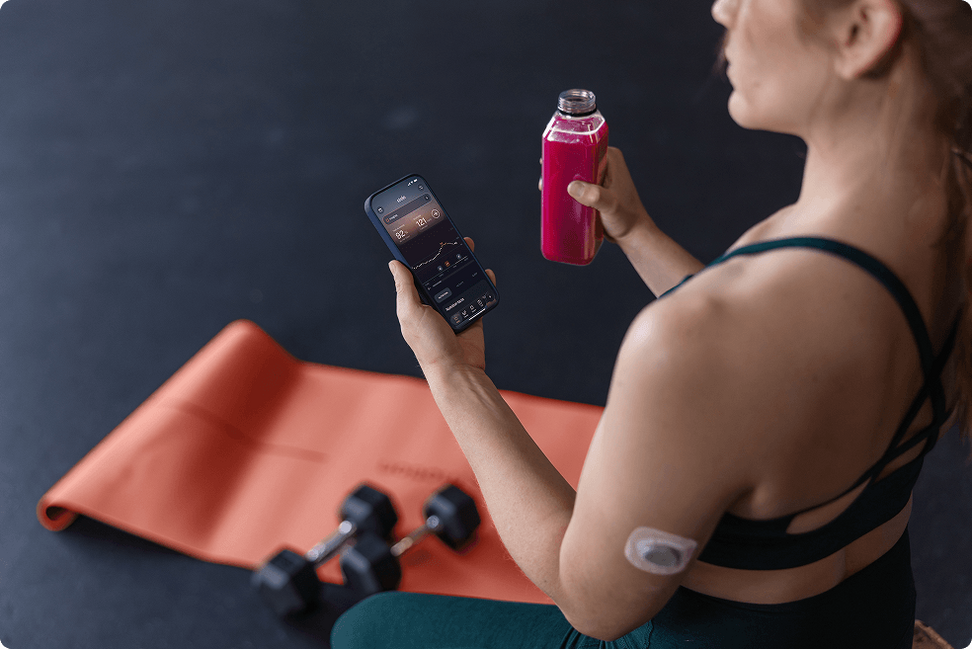
Until recently, most people had limited ways to explore how their glucose responded to everyday choices. Using a glucose biosensor like Stelo can offer a new perspective.
Instead of relying only on broad recommendations, you can begin to see how meals, sleep, physical activity, stress, and daily routines influence your own glucose patterns. Sometimes those observations confirm what you'd expect. Other times they challenge assumptions.
A food that seems like it should produce a large glucose response may have less impact than anticipated. A seemingly small change in sleep or movement may show up in ways you didn't expect.
The goal isn't to search for perfect numbers or create rigid rules. It's to develop a deeper understanding of the patterns that make your experience unique.

Curious what this looks like in your own day-to-day?
Explore different ways to test and learn from your glucose using Stelo. From trying new meals to shifting your routine, small experiments can reveal insights that are uniquely yours. Start experimenting.
Explore different ways to test and learn from your glucose using Stelo. From trying new meals to shifting your routine, small experiments can reveal insights that are uniquely yours. Start experimenting.
Health is personal
Glycemic responses are just one example of a broader reality: people often respond differently to the same inputs. That's why one-size-fits-all advice can be a valuable starting point without always being the complete answer. General guidance helps us understand what tends to work for many people. Personal insight helps us understand what that guidance looks like in our own lives.
Research is likely to continue to reveal just how individual metabolism can be. And while there is still much to learn, one thing is becoming increasingly clear: understanding your health isn't only about knowing what's recommended. It's also about understanding how factors like food, sleep, stress, and activity, and even daily routines can affect your glucose, so you can make choices that work for you.

Curated & reviewed by: Sara Garretson
RD, CDCES
RD, CDCES
Sara Garretson is a Registered Dietitian and Certified Diabetes Care and Education Specialist. She has nearly a decade of experience providing nutrition counseling, diabetes education, and training on continuous glucose monitoring technology.
